It's hard to know everything hidden in the corners of Maison Lemaríe in Paris, but from headpieces and beads, the offer of
Seville feathers is very wide.
Today I'm only going to talk about one chapter of our
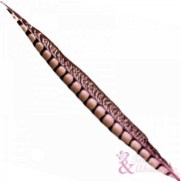
Seville feathers, those of the Pheasant, which are perhaps the most well-known to all of you. To help you differentiate them, their parts and sizes, here is a brief explanation.
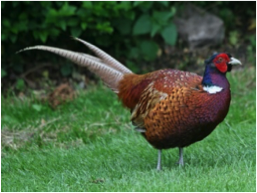
Common Pheasant: The plumage of its body is mainly coppery with iridescent purplish, red, and golden highlights, and with black feather edges that give it a scaled appearance. It also has dark violet and green streaks, and some white mottling on the upper parts. Its head and neck are blackish-green with blue and purple metallic highlights. Most of its face is covered by a red wattle.
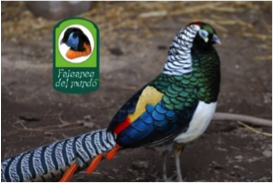
Lady Amherst's Pheasant or Silver Pheasant: The male has a green head with a red crest, a white collar with black stripes, blue wings, a yellow back, and a green and white chest. The very long tail is white with inverted "V" stripes in black. At the base of the tail, some very fine red feathers emerge. The female is much less showy, with mottled brown plumage, similar to that of the common pheasant.
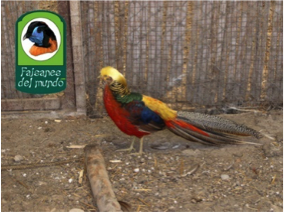
Golden Pheasant: The male is mainly red, with a yellow back and blue wings. One of its characteristics is its orange collar, and below this, it has metallic blue feathers. Its tail is very long in an inverted "V" shape. At the base of this, it has fine red feathers. The female is much less showy, with mottled brown plumage, similar to that of the common pheasant.
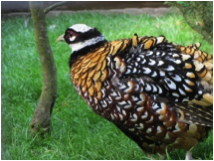
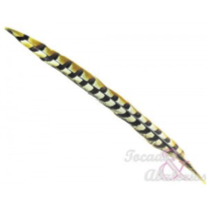
Reeves's Pheasant: The male has a white head with a black mask, an orange-yellow body with each feather tipped in black, white wings also tipped in black, and a chest the same color as the wings. It has long tails, 1 to 1.60m long, striped in black and white with orange edges.